


Is choosing a pipe that can withstand water pressure enough to ensure an efficient network? The decision involves other factors, including water characteristics, temperature, installation location, and pipe joining methods. The right pipe for a buried distribution main may differ from the one needed for a building's water supply or a pump connection inside a station.
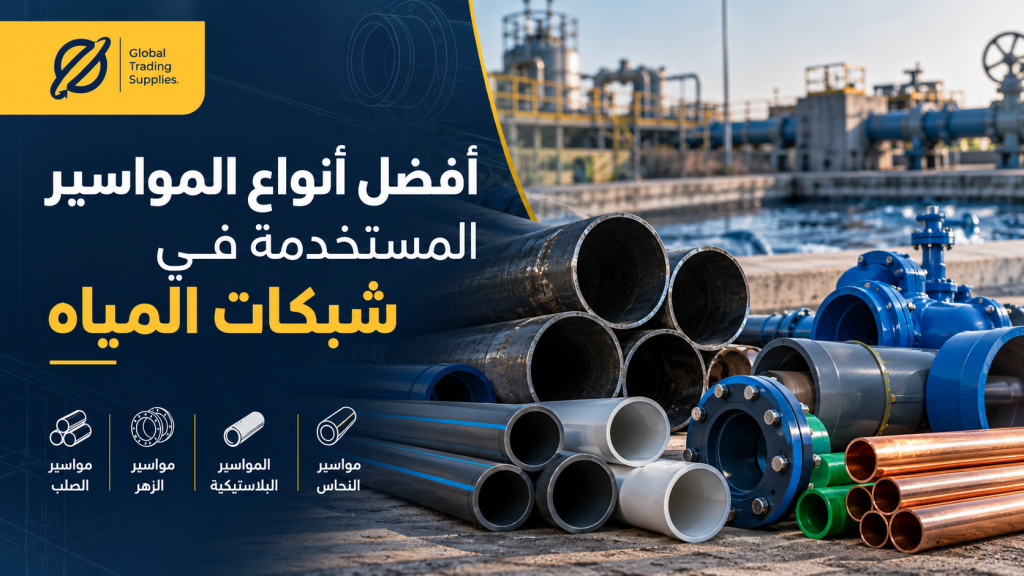
Pipes used in water supply networks come in a range of materials, including steel, cast iron, plastics, copper, and concrete. Each material has different applications and requirements. In this guide, we explain the properties of the main pipe types, compare their differences, and show you how to select pipes that meet your project's needs while helping you avoid premature replacement and maintenance costs.
Types of Pipes Used in Water Supply Networks
Understanding the types of pipes used in water supply networks starts with distinguishing between transmission and distribution mains and building plumbing systems, then comparing the materials suitable for each application. The main options include the following:
1. Steel Pipes
Steel pipes are used in water pipelines, pumping stations, and industrial applications that require suitable mechanical strength. They are available in welded and seamless forms. Selection depends on the approved specification, pipeline dimensions, and operating conditions.
Steel pipes require an assessment of internal and external corrosion protection based on water characteristics and the installation environment. Wall thickness, joints, and inspection procedures must also be reviewed. The designation 'seamless' alone does not automatically make a pipe suitable for any pressure level or for drinking-water service.
Specifying the material grade, standard, diameter, and wall thickness before requesting a quotation helps ensure the supply offer matches the project's requirements, rather than comparing technically different products that happen to have similar nominal diameters.
To understand the differences between materials and pipe types and how each is used in engineering projects, see our guide to types of iron and steel pipes, which explains their characteristics and helps you identify the type best suited to your operating and procurement requirements.
2. Ductile Iron Pipes
Ductile iron pipes are used in water transmission and distribution networks. They differ from gray cast iron in composition and mechanical properties and offer better resistance to impact and deformation than gray cast iron.
They come with different joint systems, including gasketed and flanged connections. The joint type is selected according to the pipeline design and the forces acting on it. Internal linings and external protection must also be compatible with the surrounding environment and water quality.
Selecting the right joints is just as important as choosing the pipe material, because connection methods and their requirements vary with network design and operating conditions. To explore the available options, read our article on types of water pipe fittings and connections and the main factors to consider when selecting suitable joints.
When procuring these pipes, review the pipe class, joint type, and required special fittings to ensure all network components can be assembled according to the design.
3. Gray Cast Iron Pipes
Gray cast iron pipes remain in service in some older networks. They are therefore particularly relevant to repair and replacement work and to connecting new sections to existing lines. They are relatively rigid but more susceptible to fracture under impact than ductile iron pipes.
Working with them requires checking the condition of the pipe body and its actual dimensions before choosing a repair coupling, since nominal size alone is not enough to ensure compatibility.
Understanding the pipe types used in older water networks also helps teams prepare the parts needed for maintenance and reduce service downtime.
4. Galvanized Steel Pipes
Galvanized pipes are made from steel coated with a protective layer of zinc. They are found in some water installations, older buildings, and applications specified in project requirements.
Their service life depends on water properties, galvanizing quality, and operating conditions. Pipe ends and connections also require care during installation, because a surface coating does not eliminate the possibility of corrosion.
When comparing galvanized and non-galvanized steel pipes, it is important to understand how surface protection and service conditions affect material selection. Read our article on the difference between black and galvanized steel pipes, including the key properties and applications of each type in piping networks.
Existing networks should be inspected for deposits and the condition of their internal surfaces, particularly where flow has decreased or water has changed color, before deciding whether to repair a short section or replace a longer run.
5. Plastic Pipes (PVC, uPVC, and CPVC)
PVC refers to a family of materials; uPVC is the unplasticized form, while CPVC has a modified composition that permits use in different temperature applications according to the product rating.
Pressure-rated uPVC products are used in cold-water networks, while suitable, approved CPVC products are used for hot- and cold-water plumbing. Drainage pipes must not be treated as substitutes for water supply pipes simply because they have a similar color or diameter.
Pressure rating, temperature rating, joining method, and solvent-cement instructions must be checked. Where the pipe will carry drinking water, its suitability for contact with potable water must also be verified.
6. High-Density Polyethylene (HDPE) Pipes
High-density polyethylene pipes are used in buried water mains, distribution networks, and irrigation systems. Their flexibility makes it easier to install long pipe runs and can reduce the need for some mechanical joints.
They can be joined by butt fusion, electrofusion, or suitable mechanical fittings. Joint quality depends on clean surfaces, correctly adjusted welding equipment, and appropriately trained technicians.
Selection requires specifying the material grade, standard dimension ratio (SDR), and service rating. Temperature effects, loads, and storage conditions must also be considered, rather than relying on a general description such as 'pressure-rated polyethylene pipe.'
7. Polypropylene (PPR) Pipes
PPR pipes are widely used in building plumbing systems for hot and cold water. They are joined using the thermal fusion methods specified for the system and are available in different formulations and ratings depending on the manufacturer.
PPR installations require allowances for thermal expansion and correctly positioned supports, especially in hot-water systems or exposed pipe runs. Pressure capacity also depends on operating temperature and the required design life.
Matching the pipes and fittings and following the recommended fusion procedure helps prevent reduced internal bore or weak connections caused by incorrect heating and installation.
8. Copper Pipes
Copper pipes are used in some building plumbing systems for hot and cold water. They are available in different wall thicknesses and with different joining methods. The appropriate product is selected according to system requirements and the applicable code.
Their suitability depends on water chemistry, flow velocity, and installation conditions. Connections between copper and other materials also require appropriate details to reduce the risk of corrosion.
The overall cost includes the pipes, fittings, and connection work, so it is better to evaluate the complete installed cost rather than comparing price per meter alone.
9. GRP and FRP Pipes
Glass-reinforced plastic (GRP) is a type of glass-fiber-reinforced composite pipe, while fiber-reinforced polymer (FRP) is a broader category of fiber-reinforced materials. Suitable grades are used in water transport and industrial applications.
These pipes can offer corrosion resistance and relatively low weight, but their performance depends on product composition, pressure rating, stiffness class, and the fluid being conveyed.
Buried pipelines require bedding and backfilling in accordance with the design. Pipes must also be protected during lifting and transport, because material performance depends in part on proper handling and installation.
10. Reinforced Concrete Pipes
Pressure-rated concrete pipes, including certain prestressed types, are used in some large water transmission mains. Their design and construction differ from those of concrete pipes intended for gravity drainage.
They require appropriate lifting and handling equipment, as well as joint inspections, support, and protection measures in accordance with pipeline specifications.
The pipe type and rating must be explicitly stated in procurement documents, since the term 'concrete pipe' alone does not establish suitability for pressurized water service.
Best Types of Pipes for Water Supply Networks
The best type of pipe for a water supply network depends on the pipeline's function and service conditions. Buried external networks require assessment of soil conditions, loads, and joints, while building plumbing systems call for attention to temperature, thermal expansion, and ease of maintenance.
For water well projects, the requirements for selecting pipes differ according to the well's characteristics, depth, and operating conditions. To explore the available options, read our guide to types of water well pipes and the factors that help determine the right type for each project.
Materials such as ductile iron, HDPE, and uPVC suit certain transmission and distribution applications when specified by the design. PPR, CPVC, and copper are used in particular indoor plumbing systems, while steel is used where its mechanical properties and fabrication and joining options are required.
Final material approval remains an engineering design decision. An advantage in weight or ease of installation does not automatically make one material the best choice in every other respect.
How to Choose the Right Type of Pipe
Comparing pipes for water supply networks requires information that can be reviewed before purchase. The following factors help define the requirements:
1. Determine the Operating Pressure
Review the normal operating pressure and any anticipated pressure surges during pump startup and shutdown. Then verify the ratings of the pipes, fittings, and valves, because all components must be compatible under the operating conditions.
Because operating pressure is a key factor in determining pipe specifications and wall thickness, our guide to selecting pipes according to operating pressure explains the technical criteria to review before approving the pipes and fittings for your network.
2. Review the Temperature
Determine the temperature of the water and surrounding environment, then check product limits, especially for plastic pipes whose pressure capacity varies with temperature and the required service life.
3. Select the Diameter and Wall Thickness
Calculate the required flow rate and pressure losses before selecting the diameter. Then choose the appropriate wall thickness or pipe class, noting that products with the same nominal size can have different internal diameters.
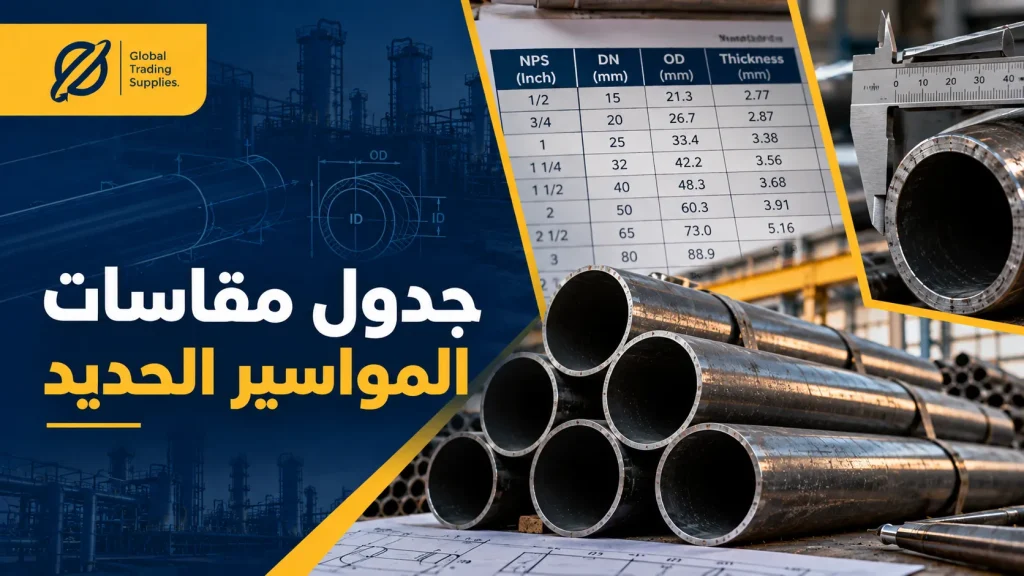
To make dimensional checks easier when preparing the project's bill of quantities, consult our steel pipe size chart for nominal sizes, external diameters, and wall thicknesses, and compare the required information before specifying the pipes for procurement.
4. Assess Soil Conditions and Installation Location
Assess traffic loads, burial depth, groundwater, and soil characteristics. Review bedding, backfilling, and anchoring requirements, since these affect pipeline performance after commissioning.
5. Verify Suitability for Contact with Water
Request documentation confirming that pipes, linings, and gaskets are suitable for the intended application, especially drinking water. A certificate of origin alone is not proof of sanitary suitability.
6. Calculate the Total Network Cost
Include the costs of pipes, fittings, transport, installation, inspection, and maintenance. Compare quotations against consistent specifications so that a small difference in purchase price does not lead to higher expenses later.
Source Steel Pipes and Fittings for Your Project from GTS
Building a piping network requires specifying materials in accordance with approved drawings and bills of quantities, from pipe type, size, and wall thickness to the fittings and flanges needed to complete the connections. Accurate procurement details help engineers and purchasing teams review line items and check that they meet project requirements before ordering.
The company Global Trading Supplies (GTS) specializes in supplying seamless carbon steel pipes and piping components for industrial and engineering projects in Egypt. The company offers pipes of Ukrainian, Russian, and Chinese origin, as well as threaded malleable fittings, high-pressure forged fittings, butt-weld fittings, and flanges.
GTS accepts bills of quantities and material schedules for reviewing requested items, checking available sizes, technical documents, and delivery timelines. This helps contractors and procurement teams prepare the materials their projects require in accordance with the applicable specifications.
Conclusion
Understanding the differences among pipes used in water supply networks provides a stronger basis for reviewing procurement quotations and selecting suitable components. Decisions become more reliable when operating pressure, temperature, water quality, installation conditions, and total cost are assessed together.
Always match the specified materials to the approved standards and inspect the supporting documentation before acceptance. Network reliability begins with clearly defined requirements and is completed through quality pipes, connections, installation, and inspection.
Frequently Asked Questions
What types of pipes are used in water supply networks?
They include steel, ductile iron, gray cast iron, galvanized steel, uPVC, CPVC, HDPE, PPR, copper, GRP, and pressure-rated concrete pipes. Suitability depends on each pipe's location, function, and rating.
What is the best type of pipe for water supply networks?
The best choice depends on the project. Operating pressure, temperature, soil conditions, water quality, and cost must all be assessed, so no single material is suitable for every network.
What is the difference between PVC and uPVC pipes?
PVC refers to a family of materials, while uPVC is its unplasticized form. Product specifications must be checked because the name alone does not establish suitability for supply, drainage, or the required pressure.
What is the difference between water supply pipes and drainage pipes?
Water supply lines generally carry water under pressure, while many drainage systems operate by gravity. Wall thickness, joints, and testing requirements therefore differ. Drainage pipes must not replace supply pipes without technical approval.
Are polypropylene pipes suitable for hot water?
PPR products rated for hot water are suitable when temperature and pressure limits and installation instructions are followed. The correct rating must be selected, with allowances for thermal expansion and support.
How do you choose the right type of pipe?
Start by defining the application, flow rate, pressure, and temperature. Then assess installation conditions, drinking-water suitability, and maintenance needs, and request a quotation that matches every detail of the approved specification.